Guide
How to choose envelopes: colours, sizes, closure types
The envelope is the first thing a guest will see and hold. We look at how to choose envelopes for your wedding invitations, from size to colour to closure type.
The envelope is the first thing a guest will see and hold. It is a preview of what is inside, and the first opportunity to make an impression. Yet envelope selection often receives less attention than the invitation itself.
In this article, we will look at how to choose envelopes for your wedding invitations, from size to colour to closure type.
1. Envelope size: the foundation that must fit
The envelope must match the invitation format, but it is not just about fitting inside.
Common formats:
- C6 (114 × 162 mm / 4.5 × 6.4 in): for A6 or postcard-sized invitations,
- DL (110 × 220 mm / 4.3 × 8.7 in): for long, narrow invitations,
- Square (e.g., 155 × 155 mm / 6 × 6 in): for square formats,
- C5 (162 × 229 mm / 6.4 × 9 in): for larger A5 invitations.
What to consider:
- the envelope should be 3–5 mm larger than the invitation,
- if inserting multiple layers (invitation + cards), you need more tolerance,
- non-standard formats may mean higher postage.
2. Envelope colour: the first visual contact
The envelope colour sets expectations. It can be neutral, or part of the design.
Neutral options:
- white: clean, universal, safe choice,
- cream/ivory: warmer, elegant,
- grey: modern, sophisticated.
Coloured options:
- shades from the wedding palette (sage, blush, burgundy...),
- contrasting colours for dramatic effect,
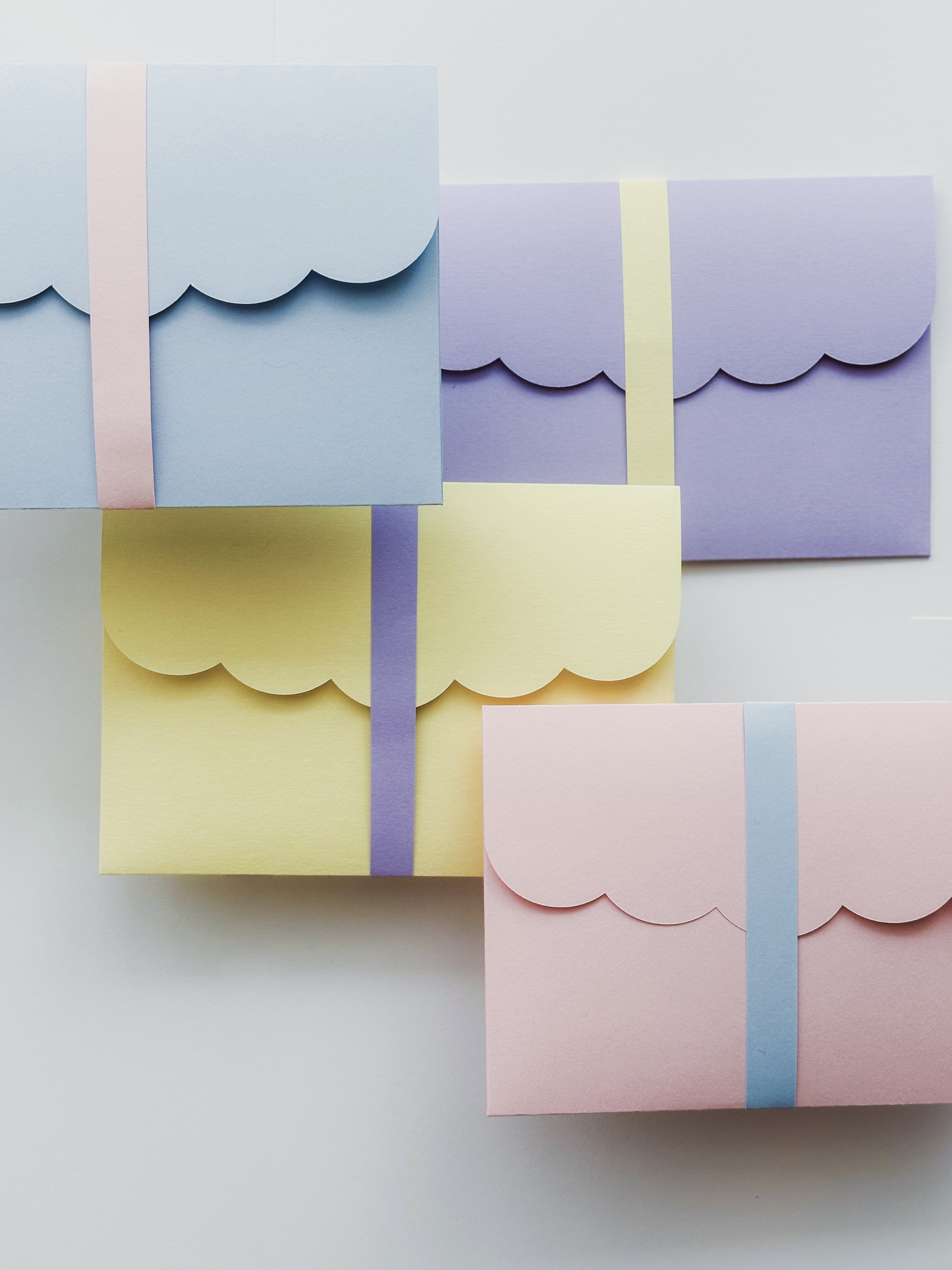
- pastel tones for a soft impression.
Tip: The envelope colour should complement the overall concept, not just the invitation itself.
3. Material and weight
The envelope should have similar quality to the invitation inside.
Typical weights:
- 100: 120 gsm, standard, functional,
- 130: 150 gsm, sturdier, better quality feel,
- 170+ gsm: premium quality.
Surface types:
- smooth: classic, easy to write on,
- textured: adds a tactile dimension,
- metallic: for a luxurious effect.
4. Closure type: a practical matter
The sealing method affects how guests open the envelope.
Common types:
Self-seal strip
- practical, quick, clean,
- suitable for larger quantities,
- needs no additional treatment.
Gummed (water-activated)
- traditional method,
- requires more time,
- can warp if handled incorrectly.
No adhesive (tuck-in flap)
- envelope is not sealed, just tucked in,
- elegant but less secure,
- suitable for hand delivery.
Seal
- wax or sticker seal,
- adds a luxurious element,
- can combine with any closure type.
5. Envelope liner
A liner is decorative paper inside the envelope that guests see when opening.
Why consider a liner:
- adds surprise and a luxurious detail,
- can carry a pattern, colour, or texture,
- connects the envelope with the invitation design.
When it is useful:
- luxury or bespoke invitations,
- when you want a "wow" effect on opening,
- if the envelope itself is simple.
6. Printing and calligraphy
The envelope can be plain, or part of the visual story.
Options:
Plain envelope
- addresses written by hand or printed on labels,
- simple, functional.
Printed envelope
- return address on the flap,
- couple's monogram or logo,
- decorative elements.
Calligraphic addresses
- hand calligraphy adds a personal, luxurious character,
- higher cost but striking effect,
- alternative: calligraphy font printed directly on the envelope.
7. Practical tips for selection
Order extra:
- allow for 10: 15% more in case of errors,
- some envelopes may get damaged during addressing.
Test before printing:
- verify the invitation fits in the envelope,
- try sealing and opening the envelope,
- send a test letter by post.
Consider postage:
- non-standard formats or heavier envelopes may cost more,
- check current postal rates.
8. Envelopes and sustainability
If sustainability matters to you:
Eco-friendly options:
- recycled papers,
- envelopes without plastic windows,
- natural materials without bleaching,
- FSC-certified papers.
Alternatives to envelopes:
- belly bands instead of envelopes,
- folding invitations that close themselves,
- digital invitations for some guests.
9. Common mistakes when choosing envelopes
Wrong size:
- too tight envelope = crumpled invitation,
- too large = contents shift around.
Incompatible colours:
- envelope and invitation do not "match",
- colour on screen ≠ colour in reality.
Ignoring quality:
- a cheap envelope can devalue an expensive invitation,
- envelope quality should match the contents.
In conclusion: the envelope is part of the experience
The envelope is not just packaging; it is the first chapter of the entire story. From the moment the guest pulls it from the letterbox, the experience begins. A quality envelope in the right colour with thoughtful details sets expectations and shows you care about every aspect.
Do not underestimate envelope selection. It is a small detail with a big impact.
Because a beautiful invitation deserves a beautiful first impression.