Guide
Common mistakes with wedding invitations
Small mistakes that do not look serious at first glance can complicate your entire wedding communication. We go through the most common mistakes and how to avoid them.

Preparing wedding invitations may seem straightforward, but simplicity hides pitfalls. Small mistakes that do not look serious at first glance can complicate your entire wedding communication.
In this article, we will go through the most common mistakes couples make when creating wedding invitations, and how to avoid them.
1. Too much information in one place
One of the most common mistakes is trying to fit everything onto a single invitation.
Why it does not work:
- text becomes too small and hard to read,
- the invitation looks cluttered,
- important information gets lost.
Solution:
- the main invitation contains only the basics (names, date, venue),
- additional information goes on a separate card,
- less is more.
2. Unclear or incomplete information
Guests need to know when, where, and how.
Common problems:
- missing exact address,
- unclear whether the invitation includes the evening programme,
- unclear dress code,
- missing contact for questions.
Solution:
- verify the invitation answers basic questions,
- if there is more information, use an information card,
- have someone who knows nothing about the wedding read the invitation.
3. Grammar and spelling errors
Nothing ruins an impression faster than a typo in a name or an incorrectly written date.
Most common mistakes:
- typos in names (including your own),
- wrong date format,
- errors in venue names,
- grammatical errors in the text.
Solution:
- multiple checks before printing,
- have another person proofread the text,
- watch out for autocorrect in text editors.
4. Poor readability
Beautiful typefaces do not always mean readable typefaces.
Why it is a problem:
- decorative fonts can be difficult to read,
- text size too small,
- insufficient contrast between text and background.
Solution:
- use decorative fonts sparingly (names, headings),
- keep main information in a well-readable font,
- test readability on a printed sample.
5. Ignoring envelope format
The invitation and envelope must work together.
Common mistake:
- the invitation is larger or smaller than the envelope,
- the invitation does not fit in the envelope without bending,
- non-standard formats may mean higher postage.
Solution:
- select invitation and envelope format together,
- verify dimensions before printing,
- consult with the printer or studio.
6. Sending too late
Guests need time to plan, especially if they are travelling.
Recommended timeline:
- Save the Date: 6: 8 months in advance,
- Wedding invitation: 3: 4 months in advance,
- RSVP deadline: at least 4–6 weeks before the wedding.
Why it matters:
- guests need to arrange accommodation,
- they need to take time off work,
- travelling guests need to book flights in time.
7. Forgetting the RSVP
Without a clear way to confirm attendance, you will be guessing how many guests will come.
What an RSVP must include:
- a clear request for a response,
- a response deadline,
- a method to respond (card, email, phone, website).
Solution:
- always include an RSVP card or provide a link,
- set a realistic deadline for responses,
- be prepared to follow up with some guests.
8. Inconsistent visual style
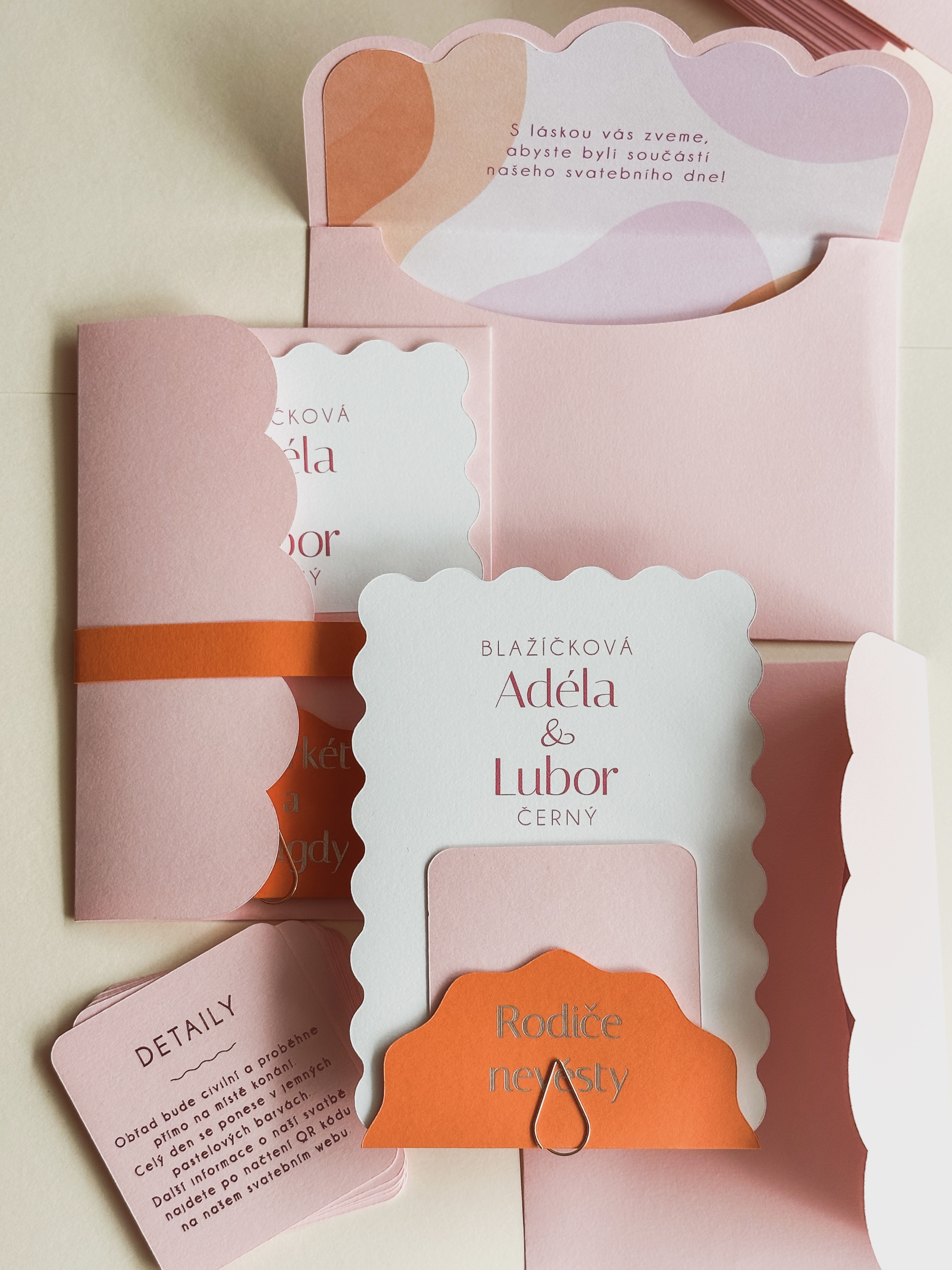
If you have multiple stationery items, they should feel like a cohesive set.
Signs of inconsistency:
- different fonts on different items,
- varying colour shades,
- conflicting illustration styles.
Solution:
- order the entire suite from one studio,
- use a defined palette of colours and fonts,
- consistency creates a professional impression.
9. Underestimating production and printing
Quality stationery needs time to produce.
Common problems:
- rushed paper selection,
- insufficient time for proofreading,
- unrealistic deadlines for special techniques.
Time estimate:
- design and approval: 2: 4 weeks,
- printing and production: 1: 3 weeks,
- hand assembly: additional days to a week.
Start early and have a buffer.
10. Skipping the test print
A digital preview never fully matches the printed result.
What can be different:
- colours on paper look different,
- text may be smaller than it seemed,
- paper has a different texture than expected.
Solution:
- always request a test print or sample,
- check colours, text, and overall impression,
- give final approval only based on the physical sample.
In conclusion: mistakes can be prevented
Most mistakes with wedding invitations stem from rushing or insufficient checking. Take your time, review everything several times, and do not be afraid to ask for feedback.
Quality wedding invitations are the result of a thoughtful process, not last-minute improvisation.
Avoid these mistakes and your invitations will be not only beautiful, but also functional.